Thursday, November 19, 2015

Walnut Twig Beetle Update

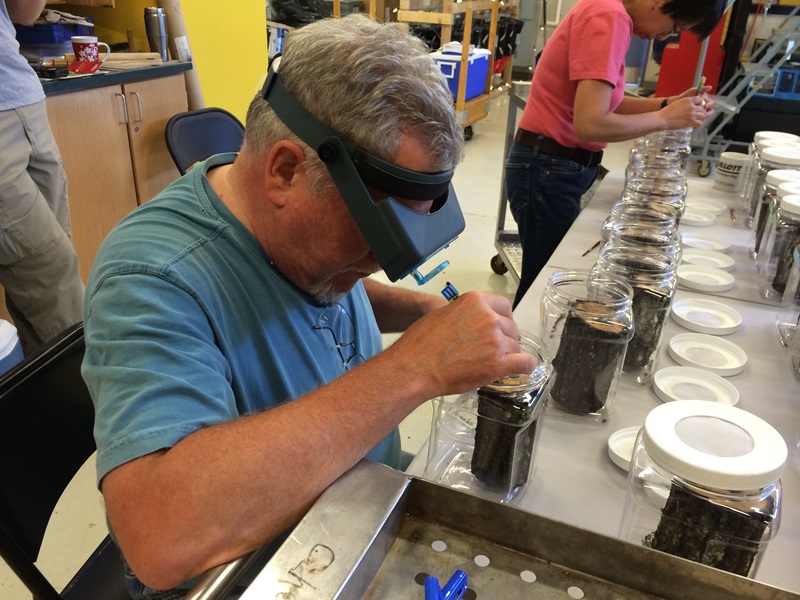
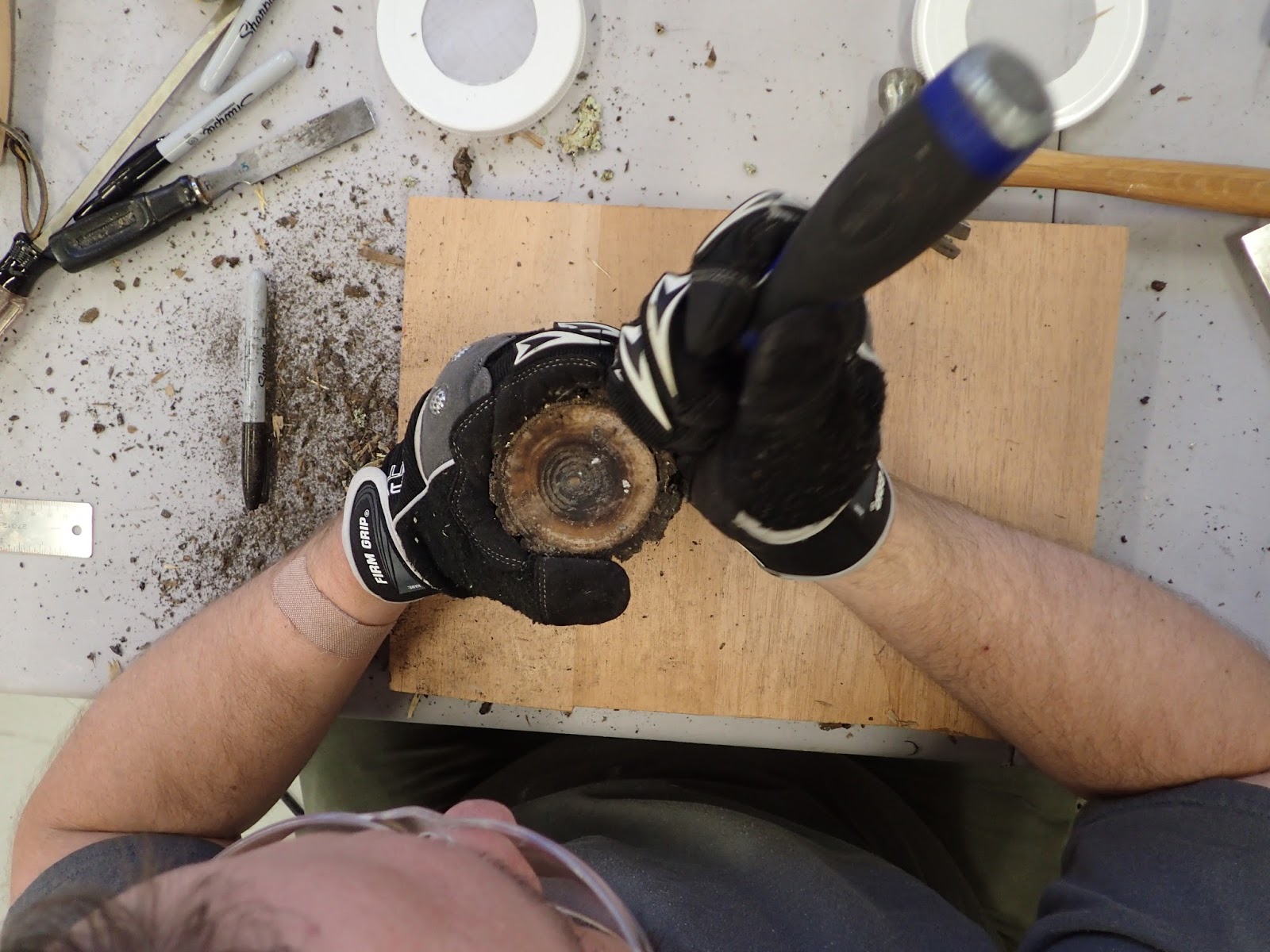
 We were back in Knoxville, TN a few weeks ago looking for walnut twig beetles and their galleries in our small bolt assays.  These were bolts treated with 3 different entomopathogenic fungi and 1 untreated control.  We carefully peeled the bark off the bolts in order to reveal beetle galleries, if any were present.

Robert Camp working on peeling a small bolt.

A small bolt peeled and ready for inspection.

Once the bark has been peeled, it is ready for inspection under a microscope.  If beetles are present, they are counted and their galleries are measured using a map ruler to quantify distance.

Michael and John counting beetles under the scope.

A beetle gallery and larvae.

Can you see the WTB larvae under the red mark?

A WTB larvae inside a gallery.

Wednesday, November 18, 2015

Sirex Trapping Survey Update

Well, we wrapped up our trap construction and initial collections for Sirex spp. in white pine stands.  And we finally caught some wasps!

Urocerus cressoni collected from one of our Cold Mountain traps.

Sirex nigricornus collectedfrom one of our Dupont S.F. traps.

We made our final collections from funnel traps during the last week of October.  The traps attracted everything from bark beetles to grasshoppers to woodwasps, but it was the bears that made the most significant impact.

Teeth marks most likely from a bear snooping around our traps.

 Evidence of a large mammal disturbing a trap at Cold Mountain.

Our lincoln log stacks will remain in the forest until summer.  We will retrieve them and rear out whatever critters have decided to colonize the trap.


Monday, September 28, 2015

Look at what we found...

We were out surveying a hemlock site in the Black Mountains of North Carolina last week and found these amazing little creatures on a small beech tree.


I would like to introduce all of you to the woolly beech aphid, Phyllaphis fagi.


Wednesday, September 23, 2015

New Documentary...

The Cradle of Forestry in America Interpretive Association has recently announced that a new documentary entitled First in Forestry: Carl Schenck and the Biltmore Forest School is premiering this weekend right on the hallowed grounds where Dr. Schenck first plied his trade in America, the Biltmore Estate.  Dr. Carl Schenck was a German forester who came to America during the 1890's and established our first forestry school.


The 1-hour film was produced by Asheville's own Bonesteel films on behalf of the Forest History Society.  Tickets for the premiere can be purchased through the First in Forestry website and proceeds will go toward promoting the film on UNC-TV.  Based on the trailer, this looks to be a high-quality, informative romp through the woods.  And the actor portraying Dr. Schenck has a fantastic mustache! 


Monday, September 14, 2015

Sirex trapping survey

Our latest project involves an effort to collect native woodwasps of the family Siricidae.  These are members of the insect order Hymenoptera, which includes ants and bees along with wasps.  The impetus behind this project is the presence of yet another introduced invasive pest, Sirex noctilio,  also called the Eurasian woodwasp.

 A recently thinned white pine stand at Dupont S.F. where some of our traps are located.

Native to Europe, Asia, and Africa, the Eurasian woodwasp has been introduced to the U.S. in portions of New York, Pennsylvania, Michigan, Vermont and in Ontario, Canada.  This pest was previously introduced in the Southern Hemisphere, where it causes significant problems for tree farmers.  Research suggests that our extensive southern pine forests could be at risk if the insect were ever introduced here.  Our trapping survey will help inform what native siricids and associated competitors and/or enemies already exist in some of our pine stands.  We hope to detect the invasive woodwasp if it has indeed been introduced.

 White pines can be relatively tall, so we have quite a few 3' lengths to stack. Photo by B. Mayfield.

 We are constructing our traps by cutting down a small (6" to 10" dia.), live white pine, cutting the main stem into 3-foot lengths, then building a "Lincoln log" stack.  Not necessarily in honor of our 16th President, rather because woodwasps are attracted to the volatiles emitted from freshly cut trees.  We pull the top of the tree next to the stack for added fragrance.


One of the traps at our Cold Mountain, NC site.

In order to get an idea of what insects are getting into our wood stack, we are hanging black funnel traps above the stack.  By the end of October, we plan on having 8 traps constructed at each of two sites in North Carolina and at one site in Northern Georgia.

 And having never identified Siricids before this experiment, I have a lot of reading to do...

Thank you Jim Meeker down in Pineville, LA for this exciting read!


Monday, August 31, 2015

Fighting Beetles with Fungi


A small walnut bolt assay was set up indoors to test the efficacy of entomopathogenic fungi.

Walnut twig beetle (Pityophthorus juglandis), a resident of the Southwestern U.S., has been causing problems in the East as early as 2010.  Only a handful of eastern states, including Tennessee, Virginia, Pennsylvania, North Carolina, Ohio, and Maryland, have records of the beetle.  Just how did these tiny beetles make it all the way from the arid southwest to the lush forests of the east? Scientists are not certain, but firewood is a likely culprit.


A mature black walnut affected by thousand cankers disease. Photo credit Bud Mayfield.


Walnut twig beetle (WTB) is an insect pest on eastern black walnut (Juglans nigra), an incredibly valuable tree found in small pockets through the central and eastern United States.  Beetles feed just under the bark on live phloem tissue and, when populations are big enough, they can girdle stems and branches causing trees to die back.  To complicate matters, WTB carries a fungal pathogen (Geosmithia morbida) that infects live tissue causing Thousand Cankers Disease.


We harvested fresh, uninfested black walnut from a supremely generous landowner's plantation in NC.  The end of those bolts were sealed with wax, so they can remain as fresh and as appealing as possible to any WTB passing by. 

This past week we were in Knoxville at the University of Tennessee Center for Renewable Carbon setting up an experiment with collaborators from the USDA Agricultural Research Service, Cornell University, and UT-Knoxville.  We are testing the efficacy of several entomopathogens to either kill, maim, or otherwise adversely impact WTBs infesting black walnut.  An entomopathogenic fungus acts like a parasite on insects and can penetrate the beetle's exoskeleton.  Our goal is to reduce beetle populations in order to limit the formation of galleries thereby reducing the impact of Thousand Cankers Disease.  Walnut trees have a better chance of survival if beetle populations can be reduced or eliminated.


Entomologist Michael Griggs with ARS mixing up a batch of entomopathogen spray.


One of our small bolts being treated with entomopathogenic fungi.


Entomologist John Vandenberg with ARS populating small assay bolts with WTB. Photo credit Bud Mayfield


Louela Castrillo from Cornell University populating small assay bolts with WTB. Photo credit Bud Mayfield.


Robert Camp with UT-Knoxville deploying a treated large bolt into one of our infested trees.


One of our treated bolts secured with rope in the canopy of an infested walnut tree.  Photo credit Bud Mayfield.


Thursday, August 6, 2015

Boy Scout Troop 91

"The best time to plant a tree is twenty years ago.  The second best time is now" - Anonymous

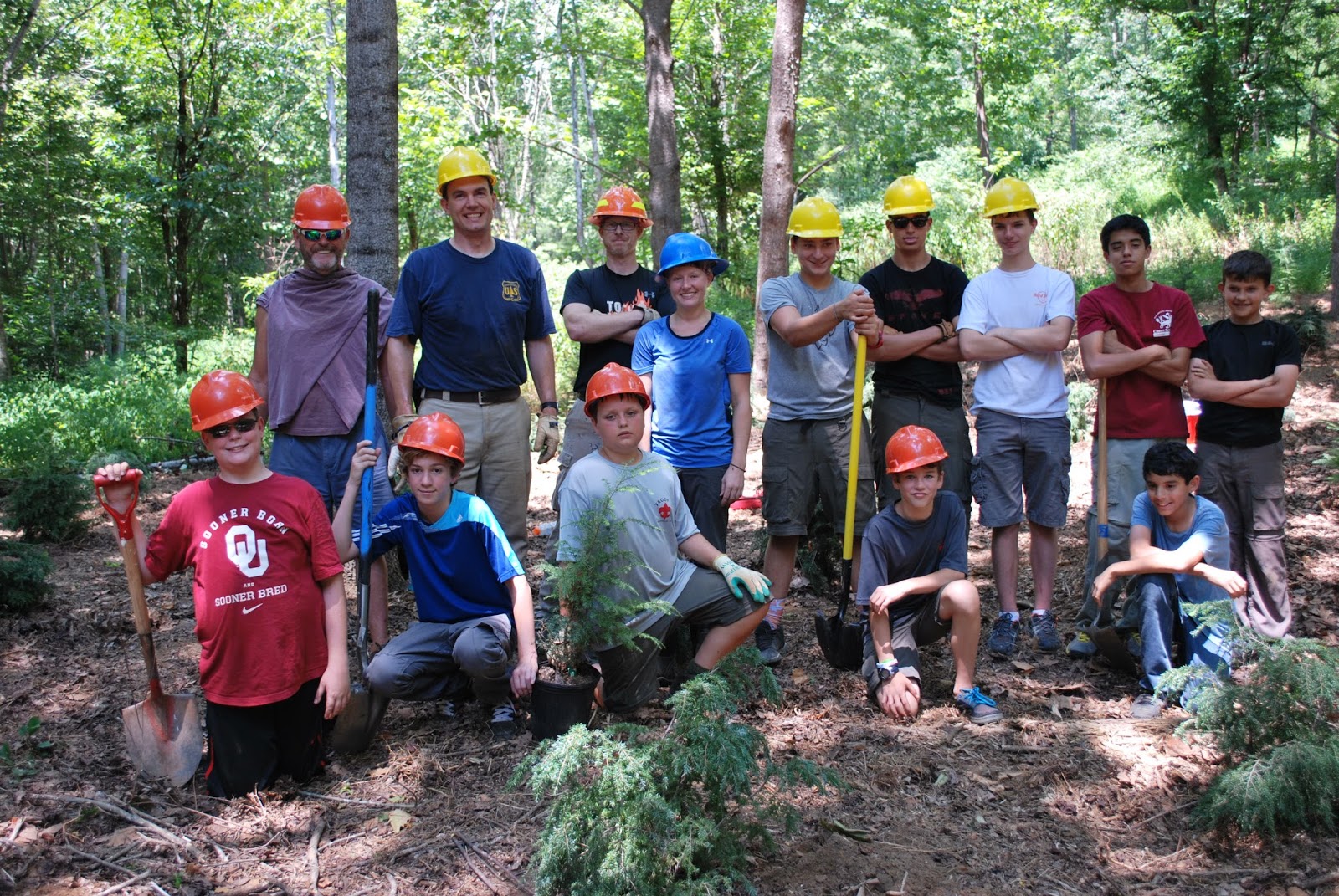
Boy Scout Troop 91 planting trees at our NC insecatry.  (Photo Credit - Julia Kirschman)

I just wanted to say another big thank you to our volunteer tree planters.  May the forest be with you!