Thursday, March 17, 2016

Working in the Mark Trail Wilderness

On a recent visit to an ongoing field experiment in the mountains of Georgia, my colleague mentioned that we had just passed into the Mark Trail Wilderness. 


A fact that, I freely admit, has escaped me all this time.  In my defense, we are usually focused on things like how to install our experiment 30 feet up in the canopy of a hemlock tree. But I digress.


My colleague went on to describe a brief report she had heard in the news about the recent death of an artist who illustrated comic book character Mark Trail.  I was completely ignorant of the significance of Mark Trail and the existence of his comic, but the few details she related piqued my curiosity.   

Ed Dodd started writing the comic strip "Mark Trail" in 1946.  Jack Elrod started working with Dodd in 1950 before taking over the comic in 1978.  Our hero, Mark, is a ruggedly handsome outdoorsman whose pursuit of the simple pleasures in life are often interrupted by poachers, thugs, and goons invading those peaceful settings and selfishly destroying beautiful natural areas.  Mark's career as a photojournalist and love for wilderness propel him into the fray as a hero fighting "to preserve the integrity of the American wilderness for future generations."


But it's not all confrontation and right-hooks from our sophisticated man-of-the-woods.  Mark is an intelligent instructor and advocate for your safety.


In the age of information overload, I somehow missed this gem of a comic. Lovingly illustrated, these comics are chock full of factoids about our natural world and our role in it.  I am on a mission to find out more.


Both Dodd and Elrod were natives of Georgia and outdoorsmen themselves.  These men and their comic strip showed millions that being an environmentalist is not only important, but cool.  Over the years, the comic and authors received many accolades and honors.  Not only is there a designated wilderness area named for this trendsetter, but Mark Trail is the official spokescharacter for NOAA.

Mr. Dodd passed away at the age of 88 in 1991 and Mr. Elrod passed away just this past February at the age of 91.  Thankfully, their legacy lives on through Mr. James Allen, yet another Georgian, now responsible for navigating Mark Trail in this new era of invasive species and fragmented landscapes.  

Thank you gentlemen for a creative and educational romp through our woods!

P.S. And check out this special one celebrating the 50th anniversary of the Wilderness act.


Tuesday, March 8, 2016

Good news from the greenway...

 William and Dr. Mayfield shooting ropes into a walnut tree in order to hang insect traps.

I want to introduce everyone to our young colleague William, a boy scout from the Asheville area.  William just won several awards at a local science fair for some work he collaborated with Dr. Mayfield on this past summer.

 William sorting trap collections under the microscope.


Here are excerpts from his science fair presentation:


Good work William!  We are glad you didn't find any Pityophthorus juglandis on our greenway.  Congratulations on your awards!


Tuesday, February 9, 2016

Larry O's Are Fit to Print...


A beetle in its pre-flight routine at our SC release.  Photo by Mac Stone.

It turns out we are not the only people excited about the first release of Laricobius osakensis beetles in The Carolinas.  Check out the following articles:

Predator Beetle to Combat Hemlock Pest

A Hope for Hemlocks?

First Release in The Carolinas of a New Hemlock Woolly Adelgid Pest


Thursday, January 28, 2016

A Winter Wallop...

Winter Storm Jonas blazed a historic trail this past weekend dumping snow and ice all over the east coast.  It was dangerous at times and had tragic consequences.  The power went out for millions, there was coastal flooding, flights were cancelled, work and school schedules were interrupted and record snowfalls were recorded.  A Mt. Pisgah tower keeper even had to be rescued from the mountaintop.

Thankfully, in our neck of the woods, we weathered the storm peaceably with only minor inconveniences and a mild case of cabin fever to speak of.

 Bent Creek Experimental Forest accumulated approximately 1 foot of snow.  Most of that coming on Friday the 22nd.  Temperatures were mostly in the 20s and 30s.

 If this cold winter persists and we see temperatures in the single digits we can expect a 3rd consecutive year where hemlock woolly adelgid  populations are adversely affected.

 The hemlock seedlings we planted this past year will benefit from all the precipitation.


Thursday, January 7, 2016

First release of L. osakensis in The Carolinas

We enjoyed another first in our fight against hemlock woolly adelgid (HWA) this week.  We just released over 1200 Laricobius osakensis predator beetles at 3 sites in The Carolinas!  
 
Technicians Andy Whittier and Bryan Mudder carefully releasing L. osakensis on a hemlock in Western NC.


 Each release is carefully recorded and entered into a database for monitoring.

In recent years there has been increased interest in Laricobius nigrinus as a predator of HWA.  L. nigrinus hails from the Pacific Northwest region of the U.S. and has a real knack for finding and feeding on HWA.  We had the privilege of getting our hands on Laricobius osakensis beetles that come from the same part of the world our non-native adelgid can be traced to...


...No, not that Osaka. The Osaka region of Japan.  We are hoping that L. osakensis will be a better predator of HWA than L. nigrinus because they evolved together in the same part of the world.

Our Larry O's, as I like to call them, came from the insect rearing lab at UT-Knoxville.  I was able to pick them up on Wednesday and we released them on Thursday.

 Sorting and counting L. osakensis at the rearing lab in Knoxville, TN


L. osakensis small, but mighty.


 The bossman takes his work very seriously.


L. osakensis tearing into an adelgid ovisac just before release.

Thursday, November 19, 2015

Walnut Twig Beetle Update

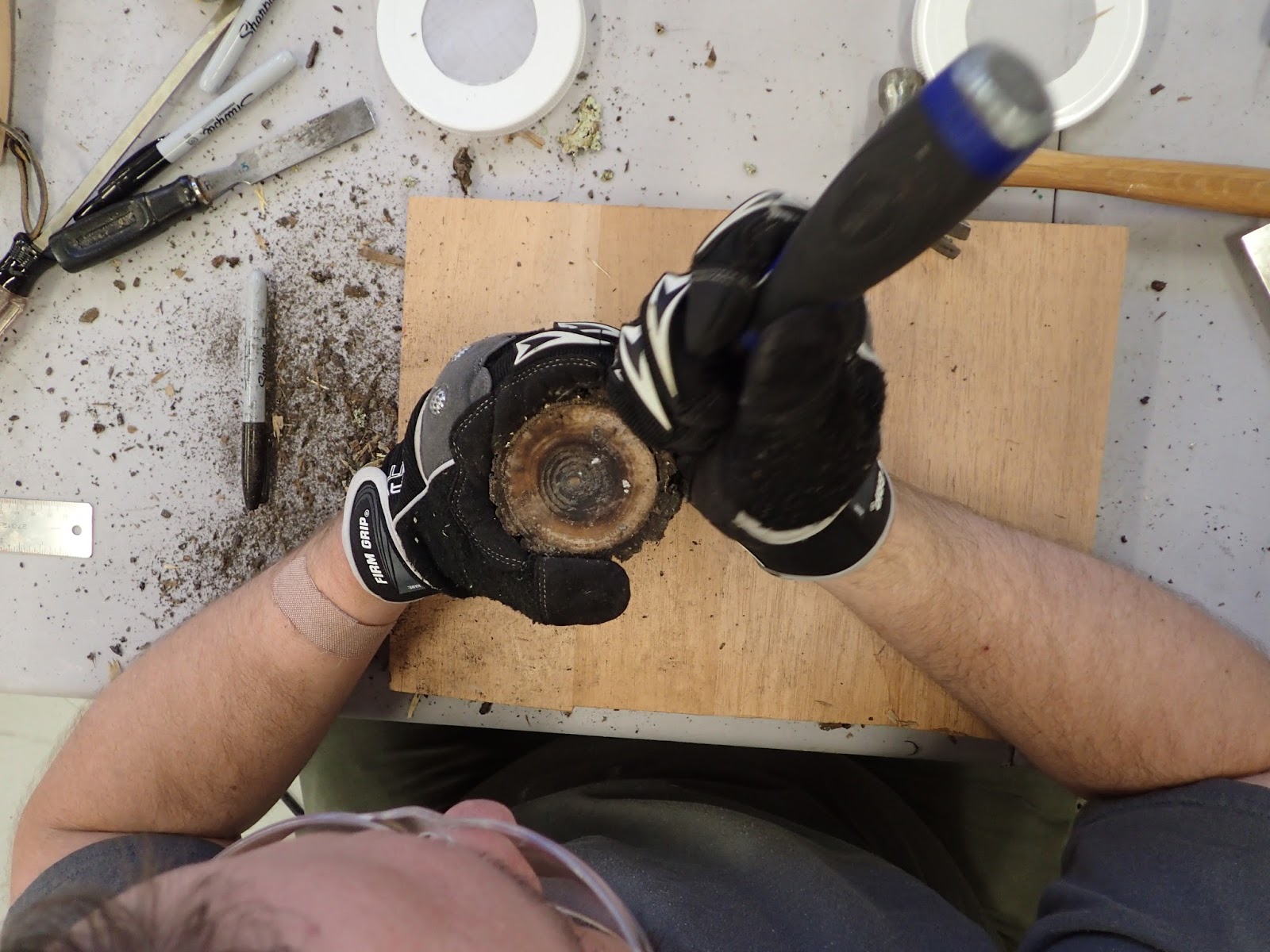
 We were back in Knoxville, TN a few weeks ago looking for walnut twig beetles and their galleries in our small bolt assays.  These were bolts treated with 3 different entomopathogenic fungi and 1 untreated control.  We carefully peeled the bark off the bolts in order to reveal beetle galleries, if any were present.

Robert Camp working on peeling a small bolt.

A small bolt peeled and ready for inspection.

Once the bark has been peeled, it is ready for inspection under a microscope.  If beetles are present, they are counted and their galleries are measured using a map ruler to quantify distance.

Michael and John counting beetles under the scope.

A beetle gallery and larvae.

Can you see the WTB larvae under the red mark?

A WTB larvae inside a gallery.

Wednesday, November 18, 2015

Sirex Trapping Survey Update

Well, we wrapped up our trap construction and initial collections for Sirex spp. in white pine stands.  And we finally caught some wasps!

Urocerus cressoni collected from one of our Cold Mountain traps.

Sirex nigricornus collectedfrom one of our Dupont S.F. traps.

We made our final collections from funnel traps during the last week of October.  The traps attracted everything from bark beetles to grasshoppers to woodwasps, but it was the bears that made the most significant impact.

Teeth marks most likely from a bear snooping around our traps.

 Evidence of a large mammal disturbing a trap at Cold Mountain.

Our lincoln log stacks will remain in the forest until summer.  We will retrieve them and rear out whatever critters have decided to colonize the trap.